


Jessica Parker,Berlin correspondent, Baltic Sea and
Ned Davies,BBC Confirm

 Getty Photos
Out on the western Baltic, a coastguard officer radios a close-by, sanctioned oil tanker.
“Swedish Coastguard calling… Do you consent to reply just a few questions for us? Over.”
Via heavy static, barely audible solutions crackle over from a crew member, who steadily lists the ship’s insurance coverage particulars, flag state and final port of name – Suez, Egypt.
“I believe this ship will go as much as Russia and get oil,” says Swedish investigator, Jonatan Tholin.
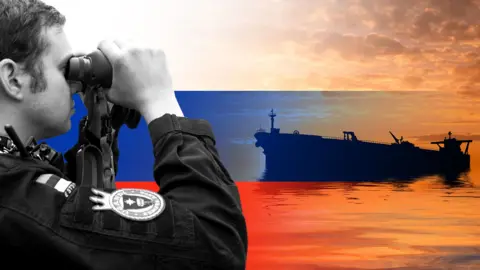
That is the entrance line of Europe’s uneasy standoff with Russia’s so-called “shadow fleet”; a time period that generally refers to a whole bunch of tankers used to bypass a value cap on Russian oil exports.
After the Kremlin launched its full-scale invasion of Ukraine, many Western international locations imposed sanctions on Russian vitality, which Moscow is accused of dodging by transport oil on aged tankers usually with obscure possession or insurance coverage.
Some “shadow” ships are even suspected of undersea sabotage, illicit drone launches or “spoofing” their location knowledge.
Out on the waves, the place freedom of navigation is a golden rule, the flexibility and urge for food of coastal international locations to intervene is proscribed, although the danger they face is escalating.
Because the BBC has realized, a rising community of “shadow” ships are crusing with out a legitimate nationwide flag, which might render vessels stateless and with out correct insurance coverage.
That could be a troubling development, given many are virtually “floating rust buckets”, says senior maritime intelligence analyst at Windward AI, Michelle Wiese Bockmann. If there may be an accident, like a billion-dollar oil spill, “good luck with looking for any individual accountable to select up any value”.
Pushed by file sanctions and tighter enforcement, the variety of falsely flagged ships globally has greater than doubled this 12 months to over 450, most of them tankers, based on the Worldwide Maritime Group (IMO) database.
The BBC has been monitoring one ship that seems to have sailed with out a legitimate flag.
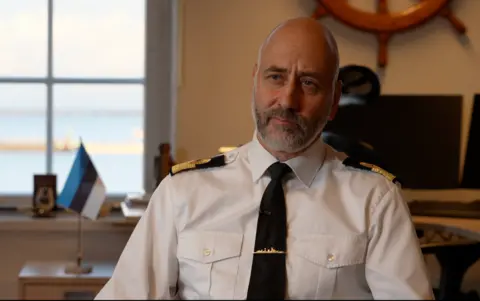
The top of Estonia’s navy, Commodore Ivo Värk, says they’ve seen dozens of such passing vessels this 12 months whereas they used to see only one or two.
The rise is alarming, he tells me, as we speak in his workplace overlooking the Gulf of Finland, a slim gateway to the main Russian oil terminals of Ust-Luga and Primorsk.
What’s extra, he suggests, it is brazen: “There isn’t any secret made about it.”
We spot the tanker Unity on the MarineTraffic app, the day we board an Estonian (British-built) Minehunter that can also be utilized in Nato’s Baltic Sentry patrols to guard essential infrastructure.
Journeying east, Unity is over 100 miles away however crusing in our course.
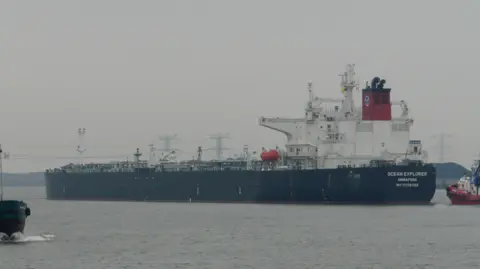
The BBC has investigated its historical past and it affords an illuminating perception into the enigmatic lifetime of a shadow ship.
Monitoring knowledge exhibits that Unity has handed by the English Channel 4 instances within the final twelve months, together with journeys between Russian ports and India; a key oil buyer that has not signed as much as the worth cap.
Initially generally known as Ocean Explorer, the tanker was in-built 2009 and flew the flag of Singapore for greater than a decade.
Again in 2019, it was named in a UN report for alleged involvement in a ship-to-ship switch with a vessel that had been sanctioned for its position in transporting gasoline to North Korea – which is amongst different international locations additionally charged with utilising elusive shadow ships.
By late 2021, the vessel – which that 12 months operated underneath the identify Ocean Vela – took the flag of the Marshall Islands however was struck from that record in 2024, a registry spokesperson advised us, as a result of the ship’s then-operator and useful proudly owning firm had been sanctioned by the UK.
The tanker seems to have had three additional names since 2021 (Beks Swan, March and Unity) and three additional flags (Panama, Russia and Gambia) however at all times retains a singular IMO quantity.
In August, ship broadcasting knowledge exhibits Unity claimed the flag of Lesotho which was designated as “false”. Lesotho is a small, landlocked African enclave kingdom that, based on the IMO, doesn’t have an official registry.
The BBC has tried to contact Unity’s listed proprietor, a Dubai-registered firm referred to as FMTC Ship Constitution LLC, however our emails and our calls went unanswered.
The useful homeowners of 60% of shadow fleet vessels stay basically unknown, based on maritime intelligence firm Windward AI.
Opaque possession constructions – and frequent identify or flag adjustments – have develop into a signature trait of the shadow fleet as a way of avoiding detection.
Purged from respected registries and having circled the drain of poor-quality options, some ships at the moment are at some extent “the place they only do not even hassle in any respect”, says Michelle Wiese Bockmann.
Unity’s most up-to-date journey noticed it sail by the North Sea in late October earlier than coming into the Baltic and passing international locations together with Sweden and Estonia – the purpose at which we noticed it.
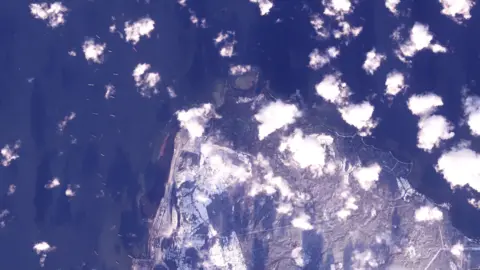
By 6 November, it was anchored exterior the Russian port of Ust-Luga the place it stays on the time of publication.
The tanker was added to the UK and EU’s ever-growing record of sanctioned vessels earlier this 12 months however, like so many others, continues to do enterprise regardless of different difficulties.
Again in January, it reportedly sheltered within the English Channel after struggling a mechanical failure throughout a storm. The next August it was reportedly detained at a Russian port because of technical points and unpaid wages.
 Planet Labs
Unity is only one of a whole bunch of vessels topic to UK and EU service and port bans as each London and Brussels attempt to enhance stress on the Kremlin.
However, Russian revenues from crude and oil product gross sales have been $13.1bn (£9.95bn) in October alone, based on the Paris-based Worldwide Vitality Company (IEA) – though this was down by $2.3bn in comparison with the identical month a 12 months in the past.
Evaluation by the Centre for Analysis on Vitality and Clear Air finds that “shadow” tankers, both sanctioned or suspected, account for 62% of shipped Russian crude oil exports, whereas China and India are by far the largest prospects for crude, adopted by Turkey and the European Union itself.
Whereas politicians speak of toughening motion, navy and coastguard officers level out {that a} nation’s energy to behave fades the additional you exit to sea.
The precise of harmless passage stays a cornerstone of maritime legislation, however stateless vessels technically will not be entitled to it.
Nations akin to France, Finland and Estonia have detained ships, they usually can accomplish that the place against the law is suspected, nevertheless such drastic controls stay a comparatively uncommon occasion.
“There is a complexity related to it,” argues Commodore Ivo Värk. “With the Russian presence subsequent to our borders, the danger of escalation is just too excessive to do it regularly.”
 Frans Sanderse
The Estonians communicate from expertise.
After they tried to intercept a flagless tanker in Could, Russia briefly deployed a fighter jet and has “consistently” had about two naval vessels within the Gulf of Finland since, says Commodore Värk.
The concern of escalation sits alongside broader issues of economic retaliation if a extra aggressive method have been to be taken.
“Daily within the Baltic, there’s suspicious exercise,” a Nato official advised the BBC, talking on the situation of anonymity. However, the official added, “we do not need to be cowboys and leaping on ships. The act of monitoring ships is a deterrent in itself”.
“Freedom of navigation is the lifeblood of all of our economies.”
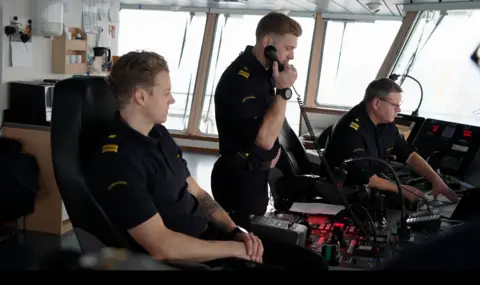
Again on the bridge of the Swedish coastguard ship, the radio name with the sanctioned tanker has wrapped up.
“Thanks in your co-operation,” says the officer because the vessel carries on in direction of Russia.
The trade lasted simply over 5 minutes.
“It’s essential see it in a bigger perspective,” says investigator Jonatan Tholin after I counsel these measures seem lower than muscular: “This info can be utilized in our maritime surveillance.”
However as Europe steps up checks and watches the waves, Windward’s Michelle Wiese Bockmann spies one thing else: “You may actually see the worldwide rules-based order crumbling by the sanctions-circumventing ways of those vessels.”
There’s a lot at stake for the surroundings and on safety, she says, and in the meantime “the darkish fleet is getting darker”.
The BBC approached Russia’s embassy in London for remark. In response, a spokesman mentioned that the West’s “anti-Russian sanctions” have been “illegitimate” and “undermine established ideas of world commerce”.
“Labelling ships used to export Russian oil as ‘shadow fleet’ is discriminatory and deceptive,” the embassy mentioned, and cases of invalid flags have been usually right down to “simply resolved” points akin to administrative delays.
It was sanctioning international locations, the spokesperson mentioned, that had “heightened” the dangers by “forcing shipowners and operators to navigate an more and more fragmented and restrictive regulatory panorama”.
Further reporting by Adrienne Murray, Michael Steininger and Ali Zaidi

